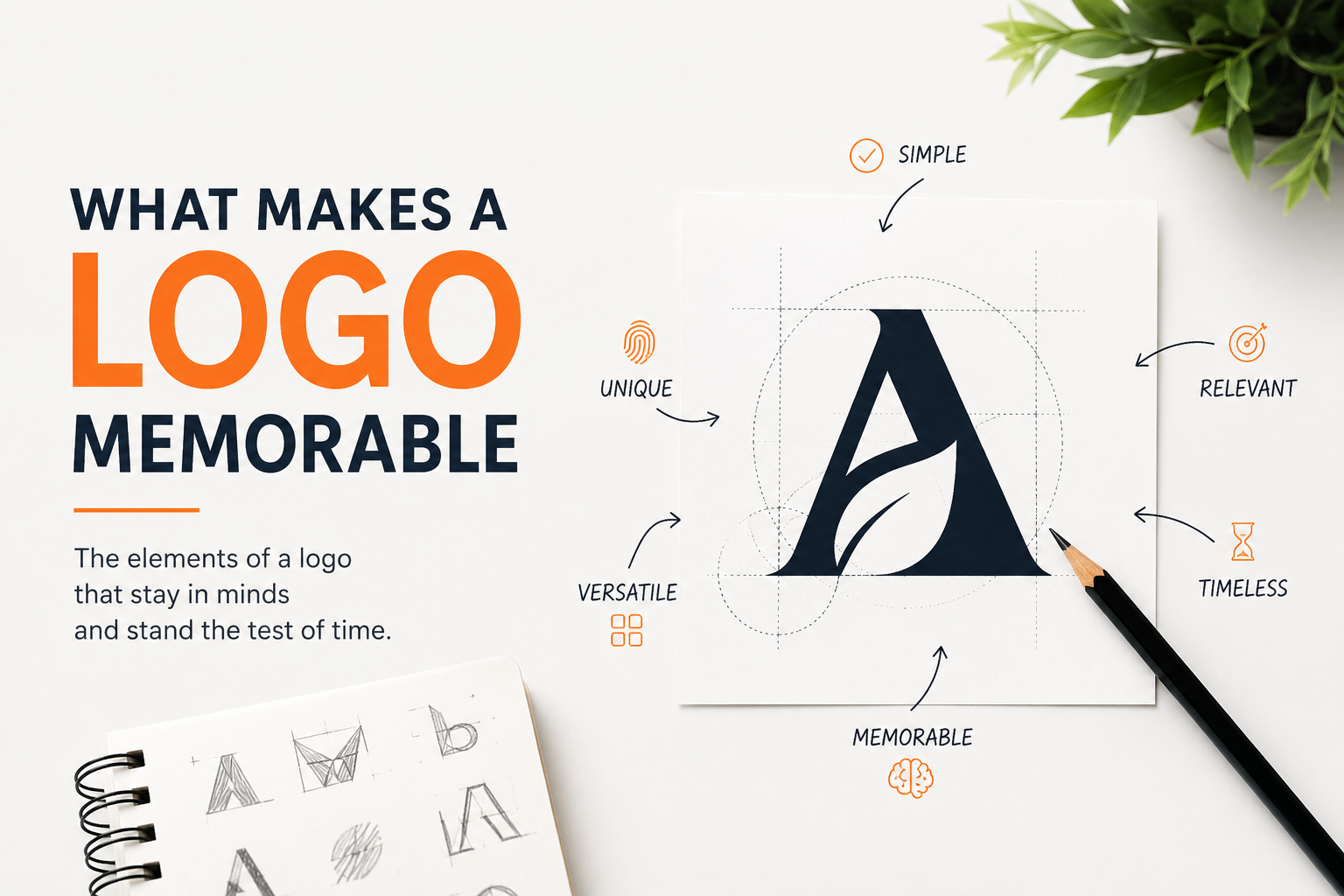
What Makes a Logo Memorable

What Makes a Logo Memorable?

What Makes a Logo Memorable

What Makes a Logo Memorable?

"A logo isn't just decoration. It's the first word your brand speaks — often before you get a chance to say anything at all."
Think about the logos burned into your memory. The golden arches. The swoosh. The bitten apple. None of them describe what the company does — yet you know exactly who they are. That's not luck. That's design working at its highest level. At Fuzebox Media, we work with businesses every day who want a logo that "looks nice." We gently push back. A logo shouldn't just look nice — it should be unmistakable. Here's what separates logos people remember from logos people scroll past.

RECOGNITION SPEED
400ms
How fast the brain identifies a familiar logo — faster than reading a word
BRAND COLOR RECALL
80%
Increase in brand recognition when consistent color is used across touchpoints
01Simplicity — the hardest thing to achieve
The most iconic logos are often the simplest. Simplicity makes a logo faster to recognize, easier to reproduce, and more versatile. If you can’t sketch it from memory after seeing it once, it’s probably too complex. Every element should earn its place. Think of Nike’s swoosh — a single curve drawn in seconds, worth billions in brand equity.
02 Distinctiveness — owning visual territory
A memorable logo looks like nothing else in its space. That means resisting trends and committing to a visual idea that’s genuinely yours. FedEx looks nothing like UPS. Apple looks nothing like Microsoft. Distinctiveness is what stops a thumb from scrolling — and what makes people say “I’ve seen that before.”
03 Relevancewithout being literal
A great logo feels right for its brand without spelling it out. Amazon’s logo doesn’t show a warehouse — it shows a smile and an arrow from A to Z, communicating customer happiness and breadth of range in one elegant swoop. A law firm doesn’t need scales. A tech company doesn’t need a circuit board. Evoke the feeling, not the function.
04 Versatility — alive in every context
Your logo will live on a website, a business card, a 10-foot sign, and a phone screen the size of a postage stamp. A strong logo works in one color, in black and white, at tiny sizes and massive ones. McDonald’s golden arches work on a motorway billboard or a takeaway bag. If your logo breaks in any context, the design isn’t finished yet.
05 Storytelling — the hidden layer
The best logos reward a second look. FedEx hides an arrow in the negative space between the E and x. The WWF panda is built from minimal shapes yet unmistakably alive. The Tour de France logo conceals a cyclist in the letter R. These details create a sense of discovery that deepens connection — people remember what made them feel clever.
06 Consistency — repetition builds memory
Even a mediocre logo becomes familiar if used consistently over time. And a brilliant logo can be eroded if it’s constantly tweaked, stretched, or dropped on clashing backgrounds. Coca-Cola has used roughly the same script since 1887. Brand equity is built through repetition. Protect your logo like the asset it is.

The best logos don’t just identify a brand — they become symbols that carry meaning people project onto them. That’s not design. That’s culture.

Some of the world’s most recognized logos break conventional “rules” — but succeed because they execute their core idea with total conviction. Here’s what we can learn from them.

Nike Logo

Nike Logo

A single swoosh designed in 1971 for $35. Now priceless. Simplicity

Coca Cola Logo

CocaCola

Spencerian script since 1887. Unchanged for 130+ years. Consistency

amazon logo

Amazon

Amazon A smile from A to Z — happiness and breadth in one mark. Storytelling

google logo

Google

Primary colors in unexpected sequence — playful, human, warm. Distinctiveness

Starbucks

A siren that became so iconic the wordmark was dropped entirely. Versatility

Slack

11 colors, 4 shapes — a hashtag that means collaboration. Relevance


We don’t start with software. We start with questions. Who are you trying to attract? What do you want people to feel when they encounter your brand? What makes you genuinely different from every competitor in your space?

The answers to those questions — not the latest trends — drive every decision in your logo. From the weight of the letterforms to the exact hex value of your brand color, everything should trace back to strategy. A logo is often the smallest asset a business owns and the most powerful. Getting it right is worth the investment.


Insight_Image_2

The Latest Trends and Developments in Social Media

Introduction: Social media continues to evolve at a rapid pace, shaping the way we communicate, connect, and consume information. From new features and algorithm updates to emerging platforms and shifting user behaviors, the social media landscape is always buzzing with activity. In this article, we will explore the latest news and developments in the world of social media, providing insights into the trends that are shaping this dynamic realm.

  1. Rise of Video Content: Video content has become the dominant force in social media, capturing users’ attention and driving engagement. Platforms like TikTok, Instagram Reels, and YouTube continue to experience explosive growth, encouraging brands and influencers to adapt their strategies accordingly. As a result, we are witnessing an increased focus on short-form videos, storytelling through video formats, and live streaming to create authentic connections with audiences.
  2. Ephemeral Content and Stories: The popularity of ephemeral content, such as Snapchat Stories and Instagram Stories, shows no signs of waning. This format allows users and brands to share temporary, engaging content that disappears after a set period, promoting a sense of urgency and FOMO (fear of missing out). Social media platforms are continuously enhancing their stories features, introducing interactive stickers, shoppable tags, and AR filters, providing new opportunities for creative expression and marketing.
  3. Social Commerce on the Rise: Social media platforms are increasingly integrating e-commerce functionalities, blurring the lines between socializing and shopping. Instagram Shopping, Facebook Marketplace, and Pinterest Shopping are just a few examples of how brands can leverage social media to drive sales directly. These features enable users to discover, browse, and purchase products without leaving the platform, creating a seamless shopping experience and unlocking new revenue streams for businesses.
  4. Privacy and User Data Protection: With growing concerns around privacy and data security, social media platforms are under increasing pressure to prioritize user data protection. As a response, platforms have implemented stricter privacy policies, improved transparency, and enhanced user control over data sharing. Measures like end-to-end encryption, two-factor authentication, and clearer data consent mechanisms are being implemented to build trust among users and maintain the integrity of social media platforms.
  5. Influencer Marketing Evolution: Influencer marketing continues to be a powerful tool for brands to reach their target audiences. However, the landscape is evolving, with a shift towards micro-influencers and nano-influencers who have smaller, more niche followings but boast higher engagement rates and authenticity. Additionally, there is a growing emphasis on influencer authenticity, transparency, and alignment with brand values, as consumers seek genuine connections and relatable content from influencers they trust.
Insight_Image_3

The Significance of Brand Guidelines: Establishing a Consistent and Powerful Brand Identity

Introduction:

In the ever-expanding digital landscape, creating a strong and memorable brand identity is crucial for businesses to stand out from the competition. One essential tool for achieving this is a comprehensive set of brand guidelines. Brand guidelines provide a roadmap for consistent visual and verbal communication, ensuring that every touchpoint reflects the essence of the brand. In this blog post, we will explore the importance of brand guidelines and how they contribute to building a powerful and cohesive brand identity.


Maintaining Consistency:

Consistency is key when it comes to establishing a strong brand presence. Brand guidelines serve as a reference point for maintaining visual consistency across various channels, including websites, social media platforms, print materials, and more. From logo usage and color palettes to typography and imagery guidelines, a well-defined set of brand guidelines ensures that every piece of communication aligns with the brand’s unique identity, strengthening brand recognition and recall.


Establishing Brand Identity:

Brand guidelines play a pivotal role in defining and communicating the essence of a brand. They outline the brand’s mission, vision, values, and personality, serving as a guide for both internal teams and external partners. By clearly defining the brand’s voice, tone, and messaging guidelines, brand guidelines empower marketers, designers, and content creators to consistently express the brand’s core attributes, fostering a sense of authenticity and building a lasting emotional connection with the target audience.


Enhancing Brand Trust:

Consistent branding builds trust and credibility among consumers. When customers encounter a brand with a consistent visual identity and messaging, they perceive it as reliable and professional. Brand guidelines ensure that all marketing materials, advertisements, and customer communications maintain a cohesive look and feel, reinforcing the brand’s credibility and building a positive perception among consumers.


Facilitating Collaboration:

Brand guidelines act as a collaborative tool, aligning internal teams and external partners on how to represent the brand effectively. Whether it’s working with advertising agencies, designers, or content creators, brand guidelines provide a shared understanding of the brand’s visual and verbal elements. This alignment fosters a cohesive and unified brand identity across different channels and touchpoints, ensuring a seamless brand experience for customers.


Scalability and Expansion:

As businesses grow and expand, maintaining a consistent brand identity becomes even more critical. Brand guidelines serve as a foundation for scalability, enabling the brand to adapt to new markets, product lines, or communication platforms while maintaining a cohesive brand identity. With clear guidelines in place, businesses can ensure that their brand remains recognizable and relevant, even as they evolve and explore new opportunities.


Protecting Brand Equity:

Brand guidelines act as a safeguard for protecting brand equity. They provide rules and regulations for the usage of the brand’s assets, including logos, trademarks, and visual elements. By defining these guidelines, businesses can maintain control over how their brand is represented and prevent dilution or misuse of their brand assets, protecting the brand’s reputation and value.