
Chatgpt Fuzebox Media Pune

How ChatGPT Changed the Way We Work at Fuzebox Media

Chatgpt Fuzebox Media Pune

Our real experience of using AI in everyday digital marketing, content creation and client work.

When we first started experimenting with ChatGPT, we thought it would mainly be useful for writing captions, blogs and quick content ideas.

We were wrong.

Over time, ChatGPT became a part of our everyday workflow at Fuzebox Media — helping us brainstorm campaigns, structure content calendars, refine client communication, develop video scripts, research ideas and sometimes simply get past that frustrating moment when you know what you want to say but can’t find the right words.

And that’s when we realised something important:

AI isn’t replacing the creative process. It is changing how quickly we can get to the creative process.

Our Experience: From “Let’s Try AI” to “We Use It Every Day”

Like many businesses, we initially approached ChatGPT with curiosity.

Can it write a good caption?

Can it give us a reel idea?

Can it help with a blog?

The answer was yes — but the real value became visible when we started giving it context.

For example, instead of asking:

“Write an Instagram caption for a product.”

we started giving it information about the brand, its audience, tone, product, objective and the kind of response we wanted.

The output changed completely.

That was probably our biggest learning:

ChatGPT is only as good as the context you give it.
Where ChatGPT Has Actually Helped Us at Fuzebox
1. Getting Past Creative Blocks

There are days when the deadline is close and the creative idea simply isn’t coming.

Instead of staring at a blank screen, we now use ChatGPT as a brainstorming partner.

We might ask for:

10 different hooks for a reel
A more emotional version of an idea
A less salesy approach
A completely different creative direction
A stronger CTA

We don’t necessarily use the first answer.

We use it to start thinking.

And sometimes one AI-generated idea leads us to a much better human idea.

2. Making Client Communication Easier

This is one of the most practical ways we use ChatGPT.

A large part of agency life isn’t just creativity. It’s communication.

Client approvals, follow-up emails, explaining delays, presenting ideas, asking for information, giving recommendations — all of these require the right tone.

ChatGPT helps us turn:

“I know what I want to say, but I don’t know how to say it professionally.”

into:

“This sounds clear, professional and still feels like us.”

We still decide what needs to be communicated. AI simply helps us communicate it better.

3. Creating Content Faster

A social media campaign can involve:

Strategy → Ideas → Hooks → Scripts → Captions → Creatives → Stories → Ads → CTAs

Earlier, each stage could take considerable time.

Today, ChatGPT helps us structure the process much faster.

For example, when working on a campaign, we can use it to explore different:

Content pillars
Reel concepts
Carousel structures
Hooks
Ad copies
Captions
FAQs

The important part is that strategy still comes first.

AI can generate 20 ideas.

It cannot automatically tell us which one is right for a particular brand.

That’s where human experience matters.

4. Understanding the Customer Better

One of the most useful things we’ve discovered is that ChatGPT can help us look at a product from the customer’s perspective.

Instead of only asking:

“How do we sell this product?”

we can ask:

“Why would someone actually want this product?”

That small change in thinking can completely change the content.

For example, instead of talking endlessly about product features, we can explore:

Customer Problem → Product Solution → Benefit → Reason to Believe → CTA

That’s much closer to how people actually make buying decisions.

But We Also Learned What ChatGPT Cannot Do

Our experience has also taught us not to blindly trust AI.

ChatGPT can give you:

A great idea
A polished sentence
A detailed strategy
Multiple creative directions

But it doesn’t automatically know your business the way you do.

It doesn’t know the exact conversation you had with your client.

It doesn’t know why a particular customer chose your product.

And it certainly shouldn’t replace your brand’s personality.

That’s why we never look at AI output as the final answer.

We edit.

We question.

We add context.

We remove what doesn’t sound authentic.

And sometimes, we completely rewrite it.

The Biggest Lesson We’ve Learned

If there’s one thing our experience with ChatGPT has taught us, it is this:

Don’t use AI to think less. Use AI to think better.

The biggest advantage isn’t that AI can write a 500-word blog in seconds.

The real advantage is that it can help you explore possibilities much faster.

You can test five campaign ideas instead of one.

You can explore different customer perspectives.

You can turn one idea into multiple content formats.

You can spend less time on repetitive work and more time on strategy and creativity.

AI + Human Creativity: That’s Our Approach

At Fuzebox Media, we don’t believe that AI and human creativity are competitors.

We see them as collaborators.

AI brings speed.

Humans bring experience.

AI brings possibilities.

Humans bring judgement.

AI helps create.

Humans decide what deserves to be created.

And that combination has made our everyday work faster, more flexible and, in many cases, more creative.

So, Has ChatGPT Changed Our Business?

Absolutely.

But probably not in the way we initially expected.

It hasn’t replaced our creative thinking.

It has reduced the time we spend getting started.

It has helped us experiment more.

It has made some everyday tasks easier.

And most importantly, it has given us another creative partner to bounce ideas off when we’re working on a campaign, a client brief or simply trying to find a better way to communicate something.

For us, that’s the real value of ChatGPT.

Not replacing people.

Helping people do better work.

At Fuzebox Media, we’re still human-first.

We just happen to have AI sitting next to us now. 😉

Fuzebox Media
Creative Thinking. Digital Strategy. Smarter Workflows.

If you’re curious about how AI can actually be used in your business — beyond simply generating captions — let’s talk.
Business Name in India

How to Choose the Perfect Business Name in India

(Step-by-Step Guide)

Business Name in India
Choosing a business name is one of the most exciting parts of starting up. There’s a rush the moment it clicks — you say it out loud, it sounds right, and suddenly it feels like the business is real.

But here’s the catch we see all the time at Fuzebox: founders fall in love with a name based purely on gut feeling, only to find out weeks later that the domain’s taken, the trademark already belongs to someone else, or the MCA won’t let them register it.

We’ve sat across the table from a founder who had already ordered visiting cards, packaging mock-ups, and a signboard design — all before checking if the name was even legally available. Two weeks in, a trademark search brought the whole thing to a halt, and the entire branding had to be rebuilt from scratch. It’s a completely avoidable situation, and it’s exactly why this checklist exists.

So before you fall too deep in love with a name, run it through these ten checks.

1. Define Your Brand Identity

Ask yourself:

  • What products or services do you offer?
  • Who is your target audience?
  • Should the name sound premium, modern, traditional, or technical?
  • Will it still work if you expand in the future?

A name should represent your vision — not just what you’re selling on day one.

2. Shortlist Multiple Names

Never fall in love with just one name. Build a list of 10–20 options and mix styles:

  • Invented names
  • Meaningful words
  • Latin or Greek inspiration
  • Combination names
  • Acronyms

The wider the shortlist, the easier it is to spot the one that actually earns its place.

3. Check MCA Availability

Planning to register a Private Limited Company or LLP? Check whether the name is already registered on the Ministry of Corporate Affairs (MCA) portal. If something similar already exists, your application can get rejected outright.

4. Search Trademark Availability

Even if the company name is available, the trademark might not be. Search the IP India Trademark database before you finalize anything — a trademark is what actually protects your brand identity long-term.

5. Check Domain Availability

Your website is your digital identity today. Before locking in the name, check availability for:

  • .com
  • .in
  • .co.in

A short, memorable domain is always worth prioritizing over a “cooler” but harder-to-type one.

6. Check Social Media Usernames

Verify availability across:

  • Instagram
  • Facebook
  • LinkedIn
  • YouTube
  • X (Twitter)

Owning the same username everywhere makes branding — and finding you — a lot easier for your audience.

7. Google the Name

Just search it. Ask yourself:

  • Is another known business already using it?
  • Does it carry any negative associations?
  • Will customers actually be able to find you and not someone else?
8. Easy to Pronounce and Remember

A good business name should be easy to say, easy to spell, easy to remember, and easy to recommend. If people stumble over saying it out loud, they’ll stumble over recommending it too — and word-of-mouth is often a startup’s cheapest marketing channel.

9. Think Long-Term

Avoid names that box you in. If there’s even a chance you’ll expand internationally, add new product lines, or pivot slightly, choose a name that still makes sense a few years down the line — not one tied to today’s single product.

10. Get Professional Feedback

Before you register anything:

  • Ask friends
  • Ask potential customers
  • Ask branding professionals

An outside perspective almost always catches something you’re too close to see.

Final Thoughts

Your business name is more than a word — it becomes your identity, your website, your social presence, and eventually, your reputation. Spending a little extra time getting it right upfront saves a lot of time, money, and legal headaches later.

At Fuzebox Media, we help startups and businesses with:

  • Business Name Research
  • Brand Strategy
  • Logo Design
  • Domain Registration
  • Website Development
  • Digital Branding

Need help choosing the perfect business name? Get in touch with Fuzebox Media, and let’s build a brand that stands out — right from the name up.

What Makes a Logo Memorable

What Makes a Logo Memorable?

What Makes a Logo Memorable

What Makes a Logo Memorable?

"A logo isn't just decoration. It's the first word your brand speaks — often before you get a chance to say anything at all."
Think about the logos burned into your memory. The golden arches. The swoosh. The bitten apple. None of them describe what the company does — yet you know exactly who they are. That's not luck. That's design working at its highest level. At Fuzebox Media, we work with businesses every day who want a logo that "looks nice." We gently push back. A logo shouldn't just look nice — it should be unmistakable. Here's what separates logos people remember from logos people scroll past.

RECOGNITION SPEED
400ms
How fast the brain identifies a familiar logo — faster than reading a word
BRAND COLOR RECALL
80%
Increase in brand recognition when consistent color is used across touchpoints
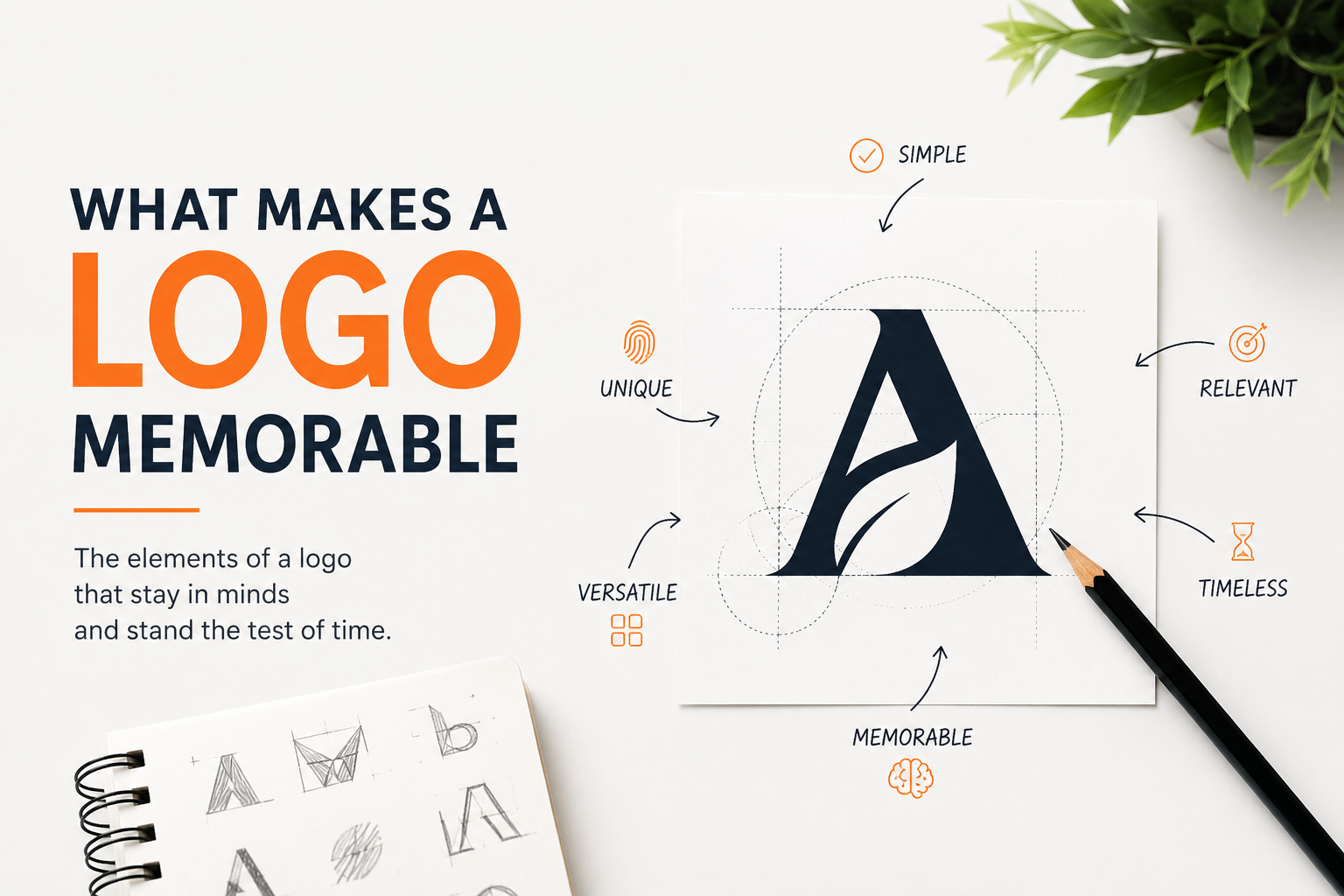
01Simplicity — the hardest thing to achieve
The most iconic logos are often the simplest. Simplicity makes a logo faster to recognize, easier to reproduce, and more versatile. If you can’t sketch it from memory after seeing it once, it’s probably too complex. Every element should earn its place. Think of Nike’s swoosh — a single curve drawn in seconds, worth billions in brand equity.
02 Distinctiveness — owning visual territory
A memorable logo looks like nothing else in its space. That means resisting trends and committing to a visual idea that’s genuinely yours. FedEx looks nothing like UPS. Apple looks nothing like Microsoft. Distinctiveness is what stops a thumb from scrolling — and what makes people say “I’ve seen that before.”
03 Relevancewithout being literal
A great logo feels right for its brand without spelling it out. Amazon’s logo doesn’t show a warehouse — it shows a smile and an arrow from A to Z, communicating customer happiness and breadth of range in one elegant swoop. A law firm doesn’t need scales. A tech company doesn’t need a circuit board. Evoke the feeling, not the function.
04 Versatility — alive in every context
Your logo will live on a website, a business card, a 10-foot sign, and a phone screen the size of a postage stamp. A strong logo works in one color, in black and white, at tiny sizes and massive ones. McDonald’s golden arches work on a motorway billboard or a takeaway bag. If your logo breaks in any context, the design isn’t finished yet.
05 Storytelling — the hidden layer
The best logos reward a second look. FedEx hides an arrow in the negative space between the E and x. The WWF panda is built from minimal shapes yet unmistakably alive. The Tour de France logo conceals a cyclist in the letter R. These details create a sense of discovery that deepens connection — people remember what made them feel clever.
06 Consistency — repetition builds memory
Even a mediocre logo becomes familiar if used consistently over time. And a brilliant logo can be eroded if it’s constantly tweaked, stretched, or dropped on clashing backgrounds. Coca-Cola has used roughly the same script since 1887. Brand equity is built through repetition. Protect your logo like the asset it is.

The best logos don’t just identify a brand — they become symbols that carry meaning people project onto them. That’s not design. That’s culture.

Some of the world’s most recognized logos break conventional “rules” — but succeed because they execute their core idea with total conviction. Here’s what we can learn from them.

Nike Logo

Nike Logo

A single swoosh designed in 1971 for $35. Now priceless. Simplicity

Coca Cola Logo

CocaCola

Spencerian script since 1887. Unchanged for 130+ years. Consistency

amazon logo

Amazon

Amazon A smile from A to Z — happiness and breadth in one mark. Storytelling

google logo

Google

Primary colors in unexpected sequence — playful, human, warm. Distinctiveness

Starbucks

A siren that became so iconic the wordmark was dropped entirely. Versatility

Slack

11 colors, 4 shapes — a hashtag that means collaboration. Relevance


We don’t start with software. We start with questions. Who are you trying to attract? What do you want people to feel when they encounter your brand? What makes you genuinely different from every competitor in your space?

The answers to those questions — not the latest trends — drive every decision in your logo. From the weight of the letterforms to the exact hex value of your brand color, everything should trace back to strategy. A logo is often the smallest asset a business owns and the most powerful. Getting it right is worth the investment.


Insight_Image_1

WhatsApp Marketing: Unleashing the Potential of Messaging Platforms

Introduction: As messaging apps continue to dominate the digital communication landscape, businesses are recognizing the immense potential of WhatsApp as a marketing tool. With its extensive user base and powerful messaging features, WhatsApp is emerging as a valuable platform for businesses to connect with customers, enhance engagement, and drive conversions. In this article, we delve into the world of emerging WhatsApp marketing, exploring its benefits, strategies, and the impact it is making in the marketing realm.

  1. Direct and Personalized Communication: WhatsApp offers businesses a direct and personalized channel to reach their target audience. With its end-to-end encryption and one-to-one messaging capabilities, businesses can communicate with customers in a secure and private manner. This enables personalized interactions, allowing brands to provide tailored customer support, share exclusive offers, send transactional updates, and build stronger relationships.
  2. Chatbots for Automated Interactions: Chatbots are revolutionizing customer service and engagement on WhatsApp. Businesses can deploy chatbots to automate responses to common queries, provide instant support, and guide customers through their buying journey. By integrating AI-powered chatbots, brands can ensure timely and efficient interactions, enhancing customer satisfaction and streamlining communication processes.
  3. Rich Media and Multimedia Engagement: WhatsApp enables businesses to go beyond plain text messages by incorporating rich media and multimedia elements. Brands can share images, videos, audio files, PDFs, and even location pins to provide a more immersive and engaging experience for customers. This capability opens up endless possibilities for showcasing products, providing tutorials, sharing testimonials, and offering visually appealing content.
  4. Group Chats for Community Building: WhatsApp group chats can be a powerful tool for building communities and fostering engagement. Businesses can create groups centered around specific interests, customer segments, or loyalty programs. These groups facilitate discussions, allow members to share experiences and insights, and provide a platform for exclusive updates and offers. By nurturing these communities, brands can cultivate brand advocates and loyal customers.
  5. WhatsApp Business API for Scalability: WhatsApp Business API enables larger businesses to scale their WhatsApp marketing efforts. This feature allows businesses to automate conversations, integrate CRM systems, and handle high volumes of customer interactions seamlessly. By leveraging the API, brands can streamline their customer support operations, implement advanced analytics, and deliver personalized experiences at scale.

6. Privacy and Data Security: WhatsApp’s commitment to privacy and data security instills trust among users. With end-to-end encryption and stringent privacy policies, businesses can assure their customers that their information is safe. This trust factor enhances the credibility of businesses using WhatsApp for marketing, fostering stronger customer relationships and brand loyalty.